
Feeling boxed in by Evernote’s limitations?
If clunky organization, weak OCR, and sluggish collaboration in Evernote have you hunting for a better document management solution, you’re far from alone.
These constant roadblocks can turn simple tasks into daily struggles for you and your team.
Every day wasted navigating Evernote’s quirks chips away at productivity and morale, costing more than just time. It’s not just inconvenient—it can disrupt your workflows, stall team adoption, and keep your paperless journey stuck in first gear.

That is why so many users are looking for smarter alternatives that offer better organization and collaboration features.
In this article, I’ll dive into the best Evernote alternatives designed for paperless office software needs, from big names like Adobe and Microsoft to purpose-built tools such as FileCenter and DocuWare.
You’ll finally get scalable, reliable document management that improves your workflow, not complicates it.
Let’s explore your options.
Quick Summary:
| # | Alternative | Rating | Best For |
|---|---|---|---|
| 1 | FileCenter → | Users needing better organization | |
| 2 | Adobe Acrobat → | Users wanting advanced PDF tools | |
| 3 | DocuSign → | Users formalizing approval workflows | |
| 4 | Google Drive → | Teams needing real-time collaboration | |
| 5 | Dropbox → | Users wanting robust file control |
1. FileCenter

Ready to ditch Evernote’s chaotic document mess?
FileCenter steps in with robust paperless office and document management, giving you the powerful filing, scanning, and editing features Evernote users often wish for instead.
With FileCenter, you’ll use familiar, Windows-style “cabinet-drawer” filing instead of Evernote’s notebook limitations, alongside advanced OCR and integrated PDF editing to keep every document right where you need it. It’s so much easier to organize, scan, and edit documents all in one place than trying to wrangle everything through Evernote’s more basic toolkit.
Here’s where things start to shift.
FileCenter gives you a serious upgrade over note-taking platforms for managing business files.
It replaces confusing tag systems with clear, virtual cabinets and drawers, helping you find what you need faster. Even better, you can scan paper files straight into searchable PDFs with one click, something that takes several extra steps in Evernote. Your invoices, receipts, or client files become text-searchable and smartly named, eliminating hours spent sorting uploads.
Plus, FileCenter’s built-in PDF editor lets you split, merge, annotate, or combine documents without leaving your filing system. This tight, desktop-based integration means you can control sensitive docs locally—no need to worry about cloud-only solutions disrupting your workflow.
You’ll get the streamlined, professional experience you want.
Key features:
- Cabinet-drawer filing built for Windows users keeps your organization simple by using familiar, hierarchical folders instead of complex tag-based or database systems you may find confusing in Evernote.
- One-click scanning and advanced OCR digitizes paper records into searchable, smart-named PDFs in seconds, automating a process that usually takes much longer and more steps.
- Integrated PDF editing and annotation tools let you create, split, merge, or add notes to documents inside your file structure, bringing more capability than basic Evernote annotations.
Verdict: FileCenter is a practical Evernote alternative for paperless document management. Many users report saving up to $20,000 a year by automating workflows. If you crave powerful scanning and real file organization without the mess, FileCenter has you covered.
2. Adobe Acrobat

Is Evernote making your paperless process harder?
Adobe Acrobat stands out with powerful PDF editing, advanced OCR, and integrated e-signature tools, giving you far more control over your documents than Evernote ever could.
If you’ve felt limited by Evernote’s basic scanning and rigid note structure, Acrobat lets you fully edit PDFs instead of simply adding annotations. This difference opens up polished, professional document workflows and ensures your paperless filing isn’t stuck with static scans or images.
Here’s the real game-changer for your digital workflow.
With Adobe Acrobat, you get more than just a place to store notes.
You gain pro-level PDF management that completely transforms how you digitize and work with paper documents. Scanned paperwork instantly becomes searchable, editable, and ready for sharing or conversion, so digitizing old paper files feels effortless. You can even export PDFs into formats like Word, giving you the flexibility Evernote can’t match.
Plus, e-signatures are handled directly in Acrobat—no extra tools required—so you can finalize contracts and approvals securely without ever leaving the document. Combined with robust PDF editing, these features eliminate the switching friction that’s usually a concern when leaving Evernote behind.
You finally get the paperless experience you wanted.
Key features:
- Advanced PDF editing and annotation tools allow you to fully revise documents, edit both text and images, and manage scanned paperwork far beyond Evernote’s limited note-based system.
- Industry-leading OCR for instant digital conversion turns paper and image-based documents into accurate, searchable, editable PDFs, making legacy files truly usable and flexible for your workflow.
- Integrated secure, legally binding e-signatures streamline document approvals, letting you execute agreements and contracts digitally from inside your PDF workspace with confidence and audit trails.
Verdict: Adobe Acrobat is a powerful alternative to Evernote if you need real professional-grade paperless office software. Its superior PDF manipulation, advanced OCR for editable conversion, and integrated digital signing cover everything Evernote misses, keeping your document workflows efficient, compliant, and fully paperless.
3. DocuSign

Is Evernote failing your document approval workflows?
DocuSign picks up where Evernote leaves off with legally binding electronic signatures, reusable templates for contracts, and powerful workflow automation so your team never chases signatures again.
If your business relies on securely signing and routing documents, you’ll notice that DocuSign empowers you to automate legally binding approvals and agreements—capabilities you just cannot get with traditional note apps.
Collaborating on contracts and approvals becomes effortless.
DocuSign streamlines how you capture signatures and manage crucial agreements as a true Evernote alternative.
Unlike basic note apps, DocuSign is built for robust digital agreement workflows. You can collect compliant electronic signatures, automate reminders, and archive signed files so nothing falls through the cracks.
Plus, you’ll love how you can standardize recurring contracts using reusable templates, making routine paperwork a breeze without recreating documents each time you send them.
Workflow automation routes every contract, sets reminders, and records signatures in one place. These capabilities help you maintain security and compliance while moving your paperless office forward.
DocuSign brings real legal weight to your paperless office.
Key features:
- Legally binding electronic signatures for business documents let your team execute formal, verifiable agreements—delivering a level of compliance and trackability unavailable in Evernote or other note-taking tools.
- Reusable contract templates with pre-set data fields allow you to standardize and accelerate repetitive workflows, so you spend less time creating and sending the same agreement.
- Automated routing, reminders, and archiving workflows track your documents’ progress, remind signers, and ensure completed files are centrally stored for auditing—bringing order to your digital agreements.
Verdict: DocuSign is a smart choice if your move away from Evernote is all about formalizing your paperless workflows. Its signature tools, reusable templates, and workflow automation support your document compliance. If you want a true agreement platform, DocuSign is built for you.
4. Google Drive
Is Evernote holding back your paperless workflow?
Google Drive offers extensive cloud storage and integrated OCR, making it simple to handle all your digital files and scans—something Evernote can’t deliver as easily.
Here’s where Google Drive stands out from Evernote: you get built-in real-time collaboration, huge storage tiers for every file type, and automatic OCR that keeps even your scanned PDFs instantly searchable. That means better organization, effortless team editing, and superior searchability right from the start.
Making the switch ultimately boosts your real productivity.
Google Drive steps in as your single hub for managing all paperless office documents, not just notes, giving you better control and visibility over files compared to Evernote.
You can import every document—PDF, image, spreadsheet—and collaborate with your team in real time on any device using familiar tools like Docs, Sheets, and Slides. This means you don’t just store information; you co-create, comment, and organize together, avoiding Evernote’s data silos.
On top of that, Google Drive’s advanced OCR automatically makes text in photos and scanned PDFs searchable, removing the hassle Evernote users face with finding information inside paper documents. Combined with scalable storage, you’re set to handle every scanned contract, invoice, or archive in one secure place.
Your paperless office finally works the way you need.
Key features:
- Generous cloud storage for every file type gives you scalable space for scans, PDFs, and more, surpassing Evernote’s free tier and accommodating your growth with ease.
- Real-time collaboration inside stored files allows your team to co-edit, share, and comment without emailing files back and forth—making teamwork much smoother than Evernote.
- Integrated OCR for images and PDFs means all your paper documents are instantly searchable, ensuring easier information access than Evernote’s document-specific OCR.
Verdict: Google Drive is a compelling alternative if you want paperless office software that’s easier to organize, faster to search, and better for collaboration than Evernote. With scalable storage and practical collaborative tools, you’re ready to upgrade your workflow and future-proof your document management.
5. Dropbox
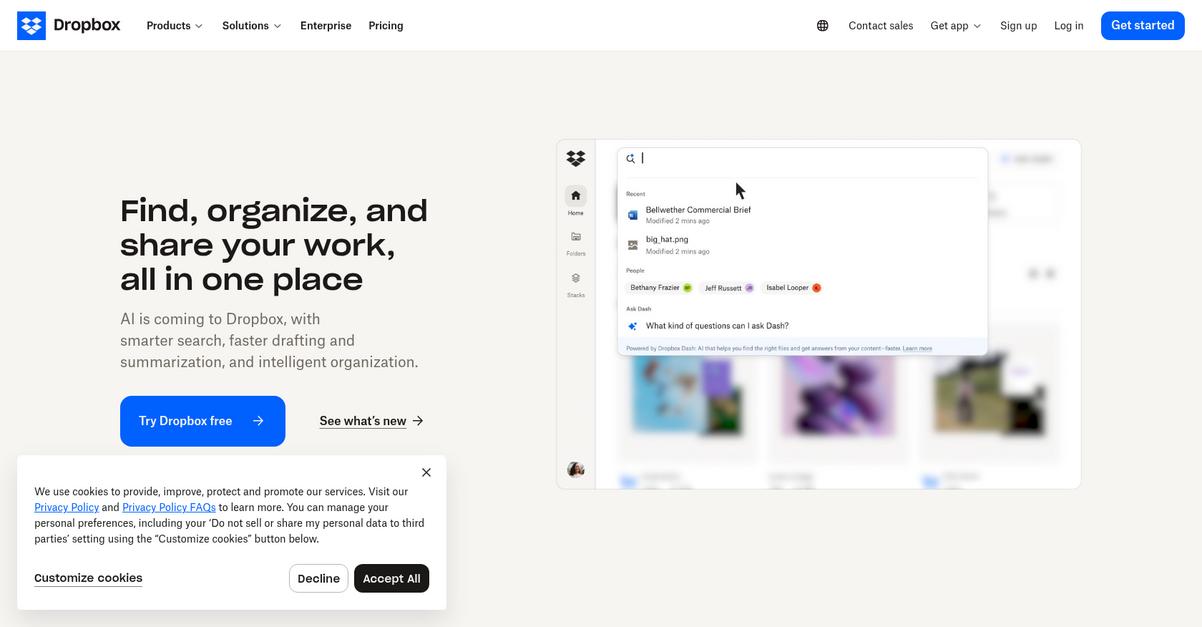
Looking for paperless document control beyond Evernote?
Dropbox goes way past basic note storage, offering universal file syncing, extensive sharing controls, and powerful file recovery options that address the common roadblocks you’ve faced with Evernote.
The real advantage is how Dropbox gives you superior file management for every document type, rather than limiting you to notes or specific formats. This means your receipts, contracts, images, PDFs, and more all stay organized together.
Getting your documents unified is more achievable than you think.
Dropbox gives you what Evernote misses—true freedom to store, organize, and share any file type, not just notes. Your workflows gain momentum when you manage everything from contracts to video files in a single cloud space.
Instead of struggling with Evernote’s limits, you’ll enjoy consistent document access on any device or platform, no matter if you’re at your desk or off-site with your phone. Restoring a file to a previous version is simple, giving you total peace of mind when mistakes happen.
Additionally, Dropbox lets you share enormous files with ease—think high-res scans, complex design assets, even video training modules—with external collaborators or clients, while keeping full control over access permissions. This flexibility tackles your team’s common roadblocks to collaboration and digital workflow adoption.
All your files, always ready and recoverable, anywhere.
Key features:
- Universal storage and syncing of every file type provides centralized access to all paperless documents, supporting everything from contracts to images—a clear upgrade from note-only platforms like Evernote.
- Extended version history and file recovery tools enable you to restore previous document versions as needed, protecting against mistakes or accidental changes and ensuring your important records are never truly lost.
- Large file sharing with robust access controls allows secure, easy sharing of big files externally, solving one of the main pain points Evernote users face when collaborating on extensive digital projects.
Verdict: Dropbox stands out as a best-in-class alternative to Evernote for anyone serious about a paperless office. You can store everything, share with anyone, and always recover lost work, giving your team more confidence and flexibility if Evernote’s limitations have held you back.
6. Microsoft OneDrive
Evernote not meeting your document workflow needs anymore?
OneDrive addresses this with Microsoft 365 integration, automatic folder backup, and advanced ransomware protection, overcoming the isolated notes and limited security you get from Evernote.
If you feel boxed in by Evernote’s basic organization, Microsoft OneDrive offers robust storage with true document workflow integration so your digital office actually stays connected and protected.
That makes all the difference right away.
With OneDrive, you move beyond isolated notes to a unified document hub right inside your Microsoft workspace.
Here’s how the integration really pays off: you can save and co-edit Word, Excel, and PowerPoint documents directly in OneDrive, keeping everything in sync without juggling attachments like in Evernote. Plus, automated folder backup keeps your desktop, documents, and pictures safe, giving your team peace of mind whether at the office or remote.
You also get ransomware detection and recovery features, something Evernote doesn’t provide. This means if you ever face a security scare, your important files aren’t gone—OneDrive helps you recover them instantly, taking the stress out of critical document storage.
So you finally get real organization and bulletproof peace of mind.
Key features:
- Microsoft 365 integration for document co-authoring brings live teamwork to your files, letting you edit and collaborate on Word, Excel, and PowerPoint instantly—something Evernote can’t match natively.
- Automatic backup of key desktop folders syncs your Desktop, Documents, and Pictures to the cloud, covering more ground than Evernote’s note-focused approach and saving you stress in case of device issues.
- Advanced ransomware detection and recovery tools protect your files from threats beyond Evernote’s scope, letting you restore your data fast and maintain a safe, truly paperless work environment.
Verdict: If you want a smarter Evernote alternative for your paperless office, Microsoft OneDrive brings integrated document collaboration, robust file protection, and automated backup. You get next-level security and efficiency, especially if your team already works with Microsoft 365 daily.
7. PandaDoc

Is Evernote holding back your workflow?
PandaDoc gives you advanced tools that help you create professional documents, automate approval workflows, and collect secure e-signatures—all areas where Evernote just can’t compete.
With PandaDoc, you get built-in e-signature capabilities along with powerful document analytics that let you track every open, view, and interaction. This brings new visibility and control over your document processes, replacing Evernote’s basic notes with tools for real digital transformation.
Here’s how PandaDoc changes the game for you.
Instead of basic note-taking, PandaDoc offers structured document creation and workflow automation that make it a serious alternative if you’re aiming for a paperless office.
If you’re looking to move beyond Evernote, PandaDoc enables you to design interactive documents with a drag-and-drop rich media editor. You can add branding, images, videos, and more, making your business proposals, contracts, and onboarding forms stand out. This goes far beyond the plain text notes found in Evernote and gives you a distinct advantage for external communications.
Additionally, the integrated e-signature feature means you can send documents for legally binding signatures, directly inside the platform. Real-time document analytics let you see exactly who viewed what and when, helping you follow up with perfect timing and insight.
This adds up to real efficiency gains.
Key features:
- Drag-and-drop rich media document editor lets you craft fully branded, interactive documents with images, videos, and more, stepping far beyond Evernote’s standard note-taking tools.
- Integrated, legally binding e-signature collection is built directly into your workflow, eliminating the need for third-party e-signature platforms and streamlining approvals.
- Real-time document tracking and analytics show who opened, viewed, or interacted with your documents, replacing Evernote’s blind spots with actionable insight.
Verdict: PandaDoc is a smart alternative to Evernote if your priority is a true paperless office with pro-level document management, e-signatures, and analytics. HR, sales, and legal teams have streamlined their work, saving hours per week by automating agreements and tracking engagement in real time.
8. DocuWare

Paperless chaos making Evernote feel outdated lately?
DocuWare offers enterprise-level workflow automation, centralized document storage, and integrated capture tools, directly addressing the limitations that often frustrate Evernote users who simply need more.
Unlike Evernote, DocuWare provides advanced document workflows and true automation, empowering your team to digitize approvals, securely manage version control, and stay compliant as you scale.
Switching to DocuWare brings real document management power.
If you want a solution that goes beyond simple note storage, DocuWare digitizes your entire workflow and centralizes documents into a secure repository, helping your business organize, find, and act on files instantly.
Here’s how DocuWare stands apart as an Evernote alternative. It automates document-centric processes—think submissions, reviews, and archiving—using rules-based workflows that handle routing and digital signatures. You’ll eliminate the manual steps Evernote can’t automate, reducing bottlenecks and improving accountability across your team.
Plus, DocuWare’s integrated document capture takes any incoming paper or digital file—whether scanned, emailed, or uploaded—into a single, searchable document pool. This means less time spent indexing, better search, and more control across your document lifecycle.
Your switch to paperless finally gets the powerful upgrade you need.
Key features:
- Advanced workflow automation with customizable rules digitizes complex document processes, such as routing for approvals and automatic archiving, which replaces manual handoffs and stagnant “stacks” of files.
- Centralized, secure document repository ensures a single source of truth for all your company documents, provides fine-grained access control, and supports regulatory compliance beyond Evernote’s capabilities.
- Integrated capture for scanned and digital files streamlines intake of all document types directly into your digital vault, so you don’t get stuck sorting through scattered folders or separate inboxes.
Verdict: DocuWare is the best Evernote alternative if you’re aiming for real paperless efficiency and workflow digitization. With robust automation, centralized storage, and compliance-focused security, you can confidently manage documents—freeing up valuable team hours for actual work, not admin.
Conclusion
Tired of Evernote slowing down your workflow?
If limited organization, poor OCR, and subpar collaboration keep holding you back in Evernote, you’re definitely not alone in seeking something more capable.
Choosing to look for a better solution just makes sense—staying stuck with frustrating tools limits your growth far more than taking the leap to a smarter alternative.
There is a better option.
After reviewing every major contender, I genuinely think FileCenter is the best alternative if you’re ready to leave Evernote’s headaches behind.
FileCenter makes document management and advanced scanning genuinely easy, delivering the seamless organization, OCR accuracy, and control you don’t get from Evernote—ideal when you want a real paperless solution.
I’ve seen users move from Evernote to FileCenter and immediately reclaim lost productivity, thanks to its intuitive desktop-first approach and business-friendly filing that’s built for actual office work.
Go ahead and start your free trial of FileCenter to take it for a spin.
Finally, get document control and peace of mind.